-az-animex- Outbreak Company - 05 -bd--hoshizor... Today
The BCD Store file is usually located in the Boot folder of a Windows 7/8.1/10 OS's System Reserved partition; which in many cases will not even have a drive letter assigned to it. So if you really want to see where these system files are located, you'll first need to go into Disk Management and give that partition a drive letter. (Note: Some OS distributions, such as the 'Embedded Standard' editions, do not have a separate System Reserved partition.) Apart from possibly needing to add a drive letter, all system files are by default hidden from view, so you'll also need to change the Folder Settings to show hidden system files. But, since the BCD file is kept open by the OS, you wouldn't be able to open it to look at it anyway! However, you can use the BCDEDIT program to make a backup copy of the BCD file which you can then open with a hex editor (to see everything) or even NOTEPAD (to see all the readable characters). [Contents of a real BCD file are linked below.]
-az-animex- Outbreak Company - 05 -bd--hoshizor... Today
If you enter "bcdedit" at a simple Command Prompt window, you'll probably see:
The boot configuration data store could not be opened. Access is denied. |
Because you need Administrator privileges to access the BCD file with BCDEDIT. So, be sure to run the Command Prompt  using a RIGHT-CLICK and selecting:
  ("Run as administrator").
The following is what you would typically see when entering the command bcdedit all by itself:
C:\>bcdedit

Windows Boot Manager
--------------------
identifier              {bootmgr}
device                  partition=\Device\HarddiskVolume1
description             Windows Boot Manager
locale                  en-US
inherit                 {globalsettings}
default                 {current}
resumeobject            {ad68f292-2870-11e3-9c80-856fbacd7f33}
displayorder            {current}
toolsdisplayorder       {memdiag}
timeout                 30

Windows Boot Loader
-------------------
identifier              {current}
device                  partition=C:
path                    \Windows\system32\winload.exe
description             Windows 7
locale                  en-US
inherit                 {bootloadersettings}
recoverysequence        {ad68f294-2870-11e3-9c80-856fbacd7f33}
recoveryenabled         Yes
osdevice                partition=C:
systemroot              \Windows
resumeobject            {ad68f292-2870-11e3-9c80-856fbacd7f33}
nx OptIn |
Note that the Boot Manager program (bootmgr) is often located in a volume without a drive letter, such as in this example, but it could have one. If there were only one partition on the drive, then it would appear in the C: partition.
The following is a dump of a Windows™ 7/8 (or Vista) Administrator console (Command Prompt window) after entering "help bcdedit" ("bcdedit /?" will give the same):
BCDEDIT - Boot Configuration Data Store Editor

The Bcdedit.exe command-line tool modifies the boot configuration data store.
The boot configuration data store contains boot configuration parameters and
controls how the operating system is booted. These parameters were previously
in the Boot.ini file (in BIOS-based operating systems) or in the nonvolatile
RAM entries (in Extensible Firmware Interface-based operating systems). You can
use Bcdedit.exe to add, delete, edit, and append entries in the boot
configuration data store.

For detailed command and option information, type bcdedit.exe /? <command>. For
example, to display detailed information about the /createstore command, type:

     bcdedit.exe /? /createstore

For an alphabetical list of topics in this help file, run "bcdedit /? TOPICS".

Commands that operate on a store
================================
/createstore    Creates a new and empty boot configuration data store.
/export         Exports the contents of the system store to a file. This file
                can be used later to restore the state of the system store.
/import         Restores the state of the system store using a backup file
                created with the /export command.

Commands that operate on entries in a store
===========================================
/copy           Makes copies of entries in the store.
/create         Creates new entries in the store.
/delete         Deletes entries from the store.

Run bcdedit /? ID for information about identifiers used by these commands.

Commands that operate on entry options
======================================
/deletevalue    Deletes entry options from the store.
/set            Sets entry option values in the store.

Run bcdedit /? TYPES for a list of datatypes used by these commands.
Run bcdedit /? FORMATS for a list of valid data formats.

Commands that control output
============================
/enum           Lists entries in the store.
/v              Command-line option that displays entry identifiers in full,
                rather than using names for well-known identifiers.
                Use /v by itself as a command to display entry identifiers
                in full for the ACTIVE type.

Running "bcdedit" by itself is equivalent to running "bcdedit /enum ACTIVE".

Commands that control the boot manager
======================================
/bootsequence   Sets the one-time boot sequence for the boot manager.
/default        Sets the default entry that the boot manager will use.
/displayorder   Sets the order in which the boot manager displays the
                multiboot menu.
/timeout        Sets the boot manager time-out value.
/toolsdisplayorder  Sets the order in which the boot manager displays
                    the tools menu.

Commands that control Emergency Management Services for a boot application
==========================================================================
/bootems        Enables or disables Emergency Management Services
                for a boot application.
/ems            Enables or disables Emergency Management Services for an
                operating system entry.
/emssettings    Sets the global Emergency Management Services parameters.

Command that control debugging
==============================
/bootdebug      Enables or disables boot debugging for a boot application.
/dbgsettings    Sets the global debugger parameters.
/debug          Enables or disables kernel debugging for an operating system
entry. |
Note: What you see above is exactly how a Vista/Win7/8 display appears; and, yes, the word "Command" in the last heading was spelled wrong by Microsoft, it should be plural (Commands) just like all the others. And if there really was only one, then the word "control" should have had an 's' after it! This was still true for a Windows 7 SP1 install we examined, and even Windows 8.1. Is this a case of "If it ain't broke, don't fix it!"? Apparently, the cost of qualifying a revised program outweighs this grammatical error.
And even though Windows™ 10 added six new commands (shown in white below), they doubled the same grammatical error (shown in red). Now it's incorrect for both of the last two command types:
-az-animex- Outbreak Company - 05 -bd--hoshizor... Today
Given this context, I cannot produce a detailed analytical essay based solely on a fragmented filename. However, I can produce a detailed on the relevant themes, character development, and narrative significance of Episode 5 of Outbreak Company , focusing on the likely subject implied by "Hoshizor..." — the elf maid Myucel .
For otaku culture, the episode poses an uncomfortable question: Can we love our fictional elves and catgirls without reducing the real, complex people around us to similar archetypes? Shinichi’s journey, anchored by Myucel’s quiet revelation, answers yes—but only if we are willing to let the characters we claim to love break our expectations. That is the true outbreak: not of monsters or magic, but of understanding. If you intended the filename to refer to a different episode, character (e.g., “Hoshizora” as in the night sky metaphor, or a different anime entirely), please provide additional context for a revised essay. -Az-Animex- Outbreak Company - 05 -BD--Hoshizor...
This stands in stark contrast to many isekai stories where non-human characters exist solely to adore or empower the (usually male) protagonist. Myucel’s arc in Episode 5 reclaims her agency. She chooses to stay with Shinichi not out of servitude but because he offers the first environment where her ears are not a curse. Her quiet strength—enduring years of contempt without losing her capacity for kindness—makes her the series’ moral compass. Returning to the truncated filename, “-Az-Animex- Outbreak Company - 05 -BD--Hoshizor...”, we see a digital ghost of the episode’s deeper meaning. The incomplete “Hoshizor...” calls out for completion, much as Myucel’s story calls for a world that sees her fully. Episode 5 of Outbreak Company is not merely a “beach episode” or a “backstory dump”; it is a carefully constructed argument that the bridge between worlds—whether fantasy empires or the distance between two hearts—is built not with magic or swords, but with empathy. Given this context, I cannot produce a detailed
This revelation is the episode’s masterstroke. Director and writer (likely Tōru Kitajima and Naruhisa Arakawa) deliberately invert the isekai convention of “fantasy races as colorful set dressing.” Myucel’s trauma is not melodramatic backstory; it is delivered with quiet matter-of-factness. She has learned to survive by making herself small, useful, and invisible. Shinichi’s horrified realization is the audience’s own: his “appreciation” of her as a moe archetype was a form of dehumanization. The episode argues that fetishizing difference—even with affection—is not the same as respecting personhood. Episode 5 is structurally central because it redefines Shinichi’s mission. The Japanese government has tasked him with spreading otaku culture (manga, anime, games) to the fantasy empire of Eldant to foster peace through “soft power.” Initially, Shinichi treats this as a dream job. But Myucel’s story forces him to confront a hard truth: cultural export without ethical grounding is just another form of imperialism. The empire’s nobility despises half-elves; if Shinichi’s otaku products ignore or even romanticize social hierarchies, he becomes complicit. This stands in stark contrast to many isekai
Shinichi’s response is what elevates Outbreak Company above typical isekai. He does not draw a sword or declare revolution. Instead, he does something smaller yet more radical: he treats Myucel with consistent, unspectacular kindness. He invites her to sit with him, to speak her mind, to share meals. He learns her full name—Myucel Hoshizora—and insists on using it. The episode culminates not in a battle but in a conversation: Shinichi promising to create a world where half-elves can live without shame. This is not naive idealism; it is the practical first step of cultural diplomacy: seeing the other as fully human. The name “Hoshizora” (starry sky) that Myucel adopts is deeply symbolic. In Episode 5, she reveals that her mother, a human, gave her that surname as a secret gift—a reminder that beauty exists beyond the empire’s cruel labels. The starry sky is vast, indifferent to race or class; it belongs to everyone. By incorporating this name into the episode’s thematic core, the narrative aligns Myucel with hope and universality. She is not a victim to be saved but a person who has already cultivated her own dignity. Shinichi’s role is merely to recognize it.
Here is that essay. In the pantheon of isekai anime, Outbreak Company (2013) stands apart not for its action or power fantasies, but for its satirical and surprisingly earnest exploration of cultural diplomacy. Episode 5, the likely subject of the truncated file name “-Az-Animex- Outbreak Company - 05 -BD--Hoshizor...”, serves as a pivotal turning point in the series. While the episode’s title varies by translation (often “The Shocking Truth! The Pretty Girl’s Ears Are Real?” or similar), its core narrative anchors on Myucel Foaran (Hoshizora) —a half-elf maid whose quiet dignity and resilience challenge both the protagonist’s preconceptions and the empire’s systemic racism. This essay argues that Episode 5 is the ethical heart of Outbreak Company , using Myucel’s character to critique otaku culture’s superficiality while simultaneously affirming its potential for genuine human (and non-human) connection. The Fragmented Subject: Reading the Filename as a Clue The provided subject line, broken and truncated, mirrors the incomplete understanding that the protagonist, Shinichi Kanou, initially has of the new world. “-Az-Animex-” suggests a fansub group’s tag, evoking the very otaku subculture the series deconstructs. “-BD-” indicates a Blu-ray release, promising visual fidelity—perhaps to capture the nuanced expressions of the characters, especially Myucel. The final fragment, “Hoshizor...”, is a direct reference to the surname Myucel adopts later in the series (“Hoshizora” meaning “starry sky”). This is no accident: Episode 5 is where Myucel transitions from a background maid to a named, emotionally complex character. The filename’s incompleteness thus becomes a metaphor for the viewer’s—and Shinichi’s—need to look beyond the surface of “cute elf girl” tropes to understand the person beneath. Deconstructing the “Moe” Shield: Myucel’s Introduction Prior to Episode 5, Myucel is presented through the lens of otaku archetypes: the demure, long-eared maid who blushes easily. Shinichi, a self-proclaimed “otaku of the people,” initially responds to her with comfortable familiarity—she fits a fantasy mold. However, Episode 5 shatters this complacency. When Shinichi casually asks about her ears, expecting a playful trope confirmation, Myucel reveals a brutal history: half-elves are outcasts, products of taboo unions, often abandoned or enslaved. Her ears, far from being a charming cosmetic feature, are a lifelong mark of persecution.
BCD Editor EXAMPLES:
If you ask for help on the "/export" switch, you'll see:
C:\>bcdedit /export /?

bcdedit /export <filename>

This command exports the contents of the system store into a file.  This file
can be used later to restore the state of the system store.  This command is
only valid for the system store.

<filename>          The filename to be used as the destination for the export.
                    If the filename contains spaces, it must be enclosed in
                    quotation marks ("").

Example:

The following command exports the system store to the specified file:

bcdedit /export "C:\Data\BCD Backup" |
So we tried the following and saw it was successful:
C:\>bcdedit /export "C:\Users\<your user name>\Documents\bcdtemp.bin" The operation completed successfully. |
After examining this backup file in our Documents folder (using HxD), our first reaction was: "Man,
this thing appears to be full of all kinds of needless 'gunk'!" It even saves the path and filename to this backup file, inside the file
itself!
Then we compared it to the original BCD file by making a copy of that file while the OS was offline (connected as a slave drive to a
different OS), and found there were MANY differences! So, the 'backup copy' is not really a true copy. And the differences go well beyond simply
changing the path name of its location.
So why is this file so 'cluttered' compared to the Windows XP boot.ini file? Its first 4 bytes
are a big clue: "regf". Reason: The BCD file has the same format as a Windows Registry hive! (For example, the NTUSER.DAT
file begins with the same 4 bytes.) And in fact, once a Windows Vista/7/8 OS has actually started booting-up, it loads the BCD file into the Windows Registry
at: HKEY_LOCAL_MACHINE\BCD00000000.
BOOTMGR Experiments:
What happens if we change the NT Disk Signature on a Windows 7 disk drive?
To test this, we used a disk editor to alter the bytes at offsets 0x1B8 through 0x1BB in the MBR (first sector of the disk drive) by simply adding 1 to each byte. If you attempt to boot a PC after doing that, you'll see the following BLACK error screen:
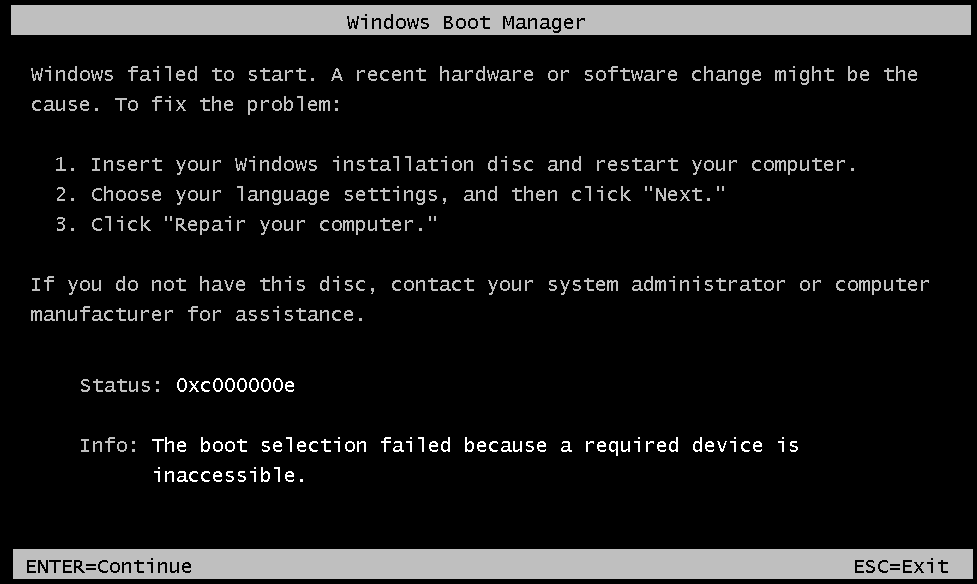
In previous Windows versions, the OS would still boot up this way; even though there was the
possibility some program that used the Disk Signature could then have problems. Note: The same error message, with Status: code of 0xc000000e,
will also be displayed if we change those NT Sig. bytes to all zeros! Only if you edit these bytes back to their original values will the PC boot-up again.
It's also possible to see such an error if your PC is somehow directed to start booting from a drive other than the normal boot drive, and the BCD
Store on that drive points to the first drive, which will obviously contain a different Disk Sig. than what is stored in that drive's BCD. Most PC BIOS have
a 'Boot Menu' (often accessible using the F12 key at boot-up) which temporarily makes whatever drive you select, be the first drive on the PC, so a
Windows 7, 8.1 or 10 OS on that drive will not have this error! (Note: Unless you plan on always keeping an original Windows OS drive
and a new Windows OS drive both connected to your PC, you should never do a new OS install with any other drives connected
to the PC!) Why? Because new Windows OS installs often make changes to a primary disk drive, even when installed to a secondary drive! Disconnect all
but the disk drive you intend to install a new Win OS on, and in the future you will be able to boot-up the new drive all by itself (or using a Boot Menu key)
without it depending upon some primary disk drive you decided to remove, or that has failed.
NOTE: The error shown above is a function of the bootmgr program! We know this, because the same error message will be displayed after
altering the NT Disk Signature on a drive that has had its entire C: Volume (where the actual Windows OS resides) removed! So, the Boot
Manager must check the NT Disk Signature before it even looks for the presence of the C: Volume.
But how does bootmgr know what those hex
bytes should be?
Answer: After examining both our copy and the original BCD file, we found the NT Disk Signature there, in the same
order as found in the MBR Sector, no less than 9 times. For our small test install of a new Windows 7 OS, this shows
where those bytes occurred (highlighted with a pink background color); along with all the other data contained in a BCD Store file.
Note: The \Boot folder of your System Reserved partition will also contain a few LOG files: BCD.LOG, BCD.LOG1 and BCD.LOG2, but the numbered files are often empty. This LOG file is a copy of the BCD file, having the same location
written inside it and all the general indications of a BCD Registry file, but about half its bytes may be different.
Have fun examining your own backup BCD copy.
Why is it so difficult to move the C: Volume under Windows 7 or later?
To clarify: Under most previous Windows installs, such as Windows 98, people who performed multi-booting or simply had many different partitions on their
PCs often used a program called Partition Magic to shrink or even completely rearrange the layout of partitions on their disk drives. But attempting
to change where the C: Volume begins under Windows 7 results in a similar BLACK screen error as above; including the same exact message: "Info: The boot selection failed because a required device is inaccessible." But with a different code: "Status: 0xc0000225."
[Note: This is true whether the correct location
is specified in the Partition Table or not; same Status code will be shown in either case. In fact, we doubt that bootmgr even looks at the
Partition Table, provided it can find the C: volume where it is supposed to be!]
This problem is similar to the one above (concerning the NT
Disk Signature), but involves the exact sector location of the C: drive's partition.
So where in the BCD file, is the sector location of the
Windows Boot Sector stored?
The reason for the question being: Although we can find our drive's NT Disk Signature in the BCD Store, we can
not find a sector location for the C: drive! Before searching, we had thought only the
BCD file would need to be updated if we moved the C: Volume. We knew how partitions are referenced in a Windows REGISTRY (see NTFS Disk Signature), but could not find any similar bytes; other than the 4 bytes of the NT Disk Sig., in our BCD file! So how
does bootmgr know where the sector offset location of a C: drive should be, and prevent booting from an OS volume we simply moved and did
not resize; even though the data in both the Partition Table and its Boot Sector (Hidden Sectors which give us sector offset to Boot Sector) have
already been updated?
NOTE: All of the following is still under construction . . . mainly because we have yet to find a solution that allows one to effectively move where a Windows 7 OS's C: drive partition begins! After using a Microsoft install DVD to REPAIR such a drive, although it did allow us to boot-up that drive and use it, the repair did not change anything permanently! After attempting to boot-up the drive again, the same error message is displayed, no matter how many times we used the DVD to 'repair' the drive!!.
Could it be as simple as the OS already having accessed the REGISTRY; with much of the system already running in Memory, it then finds the offset stored
there does not match the values in the Partition Table and/or Boot Sector, so it gives us essentially a false message, stating: "The boot selection
failed because a required device is inaccessible."? Yet, the bootmgr program could only know that if it did find and
access the Registry.
Other Experiments:
2. We next carried out the following steps on a copy of our Windows 7 OS install in order to verify our theory about why Windows 7 does this:
A) Copy the hidden file bootmgr and various folders (including "Boot\enUS" and "Boot\Fonts") from the
"System Reserved" partition to the root directory of the C:\ drive. Note: Five or six files must be 'skipped' when doing this, because the
BCD Store (and associated files) will remain in use by the OS (preventing them from being copied)!
B) Create a copy of the BCD file
in C:\Boot by using this command (as Administrator): bcdedit /export C:\Boot\BCD
C) Change the
MBR Sector, so the main OS partition is the 'Active' partition.
After that we were able to boot-up the OS from only the C: drive. In order to prove
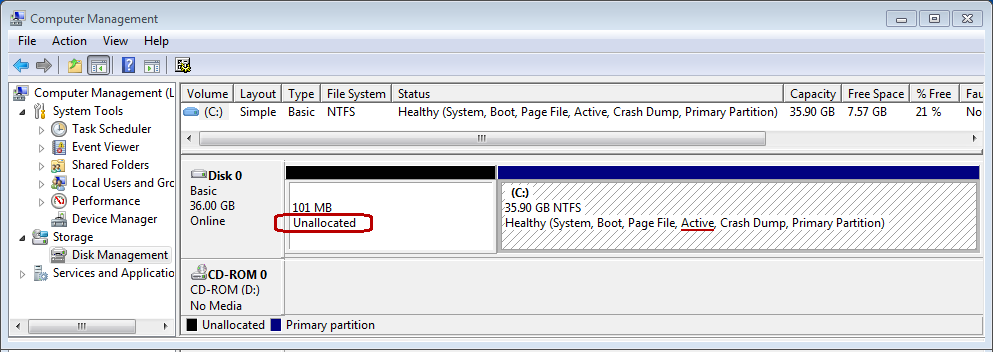
this is true, we used HxD to zero-out the entry in the Partition Table for the System Reserved partition. (Note: The reason we did not
use Windows to 'delete' the partition, is because that could have ruined being able to access it again in the future. By saving those hex bytes elsewhere
and zero-filling the entry, we can simply enter those bytes in the table again, in order to restore and access the partition!) Upon rebooting and opening
the Disk Management utility, one can graphically see this is true:
D) We shrank the size of this Volume (C:) to only 8 GB in order to run the next test below.
What about BOOTSTAT.DAT and BOOTSECT.BAK files?
E) shift the beginning of the C: drive to where the System Reserved partition had been, by correcting the data in both the
Boot Sector (VBR) and the Partition Table; not to mention, actually moving the Boot Sector and its following Volume Boot Record sectors as well

