


Author: [Generated for conceptual purposes] Publication Type: Technical & Legal Feasibility Study Date: April 15, 2026 Abstract The MeWe social network has gained traction as a privacy-respecting alternative to mainstream platforms, emphasizing no ads, no tracking, and user-controlled data. However, its interface lacks native video downloading capabilities, creating demand for a third-party solution. This paper presents the design and analysis of the MeWe Video Downloader App —a software tool enabling users to download videos from MeWe to local storage. We examine the technical architecture (API reverse engineering, media stream capture), legal implications (DMCA, Terms of Service violations, fair use), security risks, and ethical boundaries. Results indicate that while technically feasible, such an app operates in a legally ambiguous zone, requiring explicit user consent and strict adherence to copyright laws. 1. Introduction 1.1 Background MeWe (MeWe.com) hosts over 20 million users as of 2026, featuring groups, chats, and a newsfeed with video sharing. Unlike YouTube or Facebook, MeWe does not provide a download button for user-uploaded videos. This absence serves two purposes: (1) protecting content creators’ control, and (2) reducing server bandwidth from mass downloading. 1.2 Problem Statement Users frequently wish to save videos for offline viewing, archival, or educational use. Existing workarounds (screen recording, browser extensions) are inefficient or low-quality. No dedicated, cross-platform downloader exists for MeWe. 1.3 Objective To propose a fully functional MeWe Video Downloader App that extracts video streams from MeWe posts, respects user privacy, and incorporates legal safeguards. 2. Technical Architecture 2.1 Core Components The app is designed as a hybrid mobile/desktop application (React Native + Electron) with three layers:
import m3u8 import requests def download_mewe_video(video_url, session_token): headers = "Authorization": f"Bearer session_token" master = m3u8.load(video_url, headers=headers) highest_bandwidth = max(master.playlists, key=lambda p: p.stream_info.bandwidth) segments = m3u8.load(highest_bandwidth.uri, headers=headers).segments for seg in segments: resp = requests.get(seg.uri, headers=headers) with open(f"segment_seg.sequence.ts", "wb") as f: f.write(resp.content) # Concatenate with FFmpeg mewe video downloader app
“This software does not bypass any digital locks (DRM) nor store any content permanently on MeWe servers. You are solely responsible for obtaining permission from the video owner before downloading. Downloading without permission may violate MeWe’s Terms of Service and local copyright laws.” This paper is a conceptual design study and does not constitute legal advice. Actual implementation should consult an attorney specializing in internet law. Introduction 1
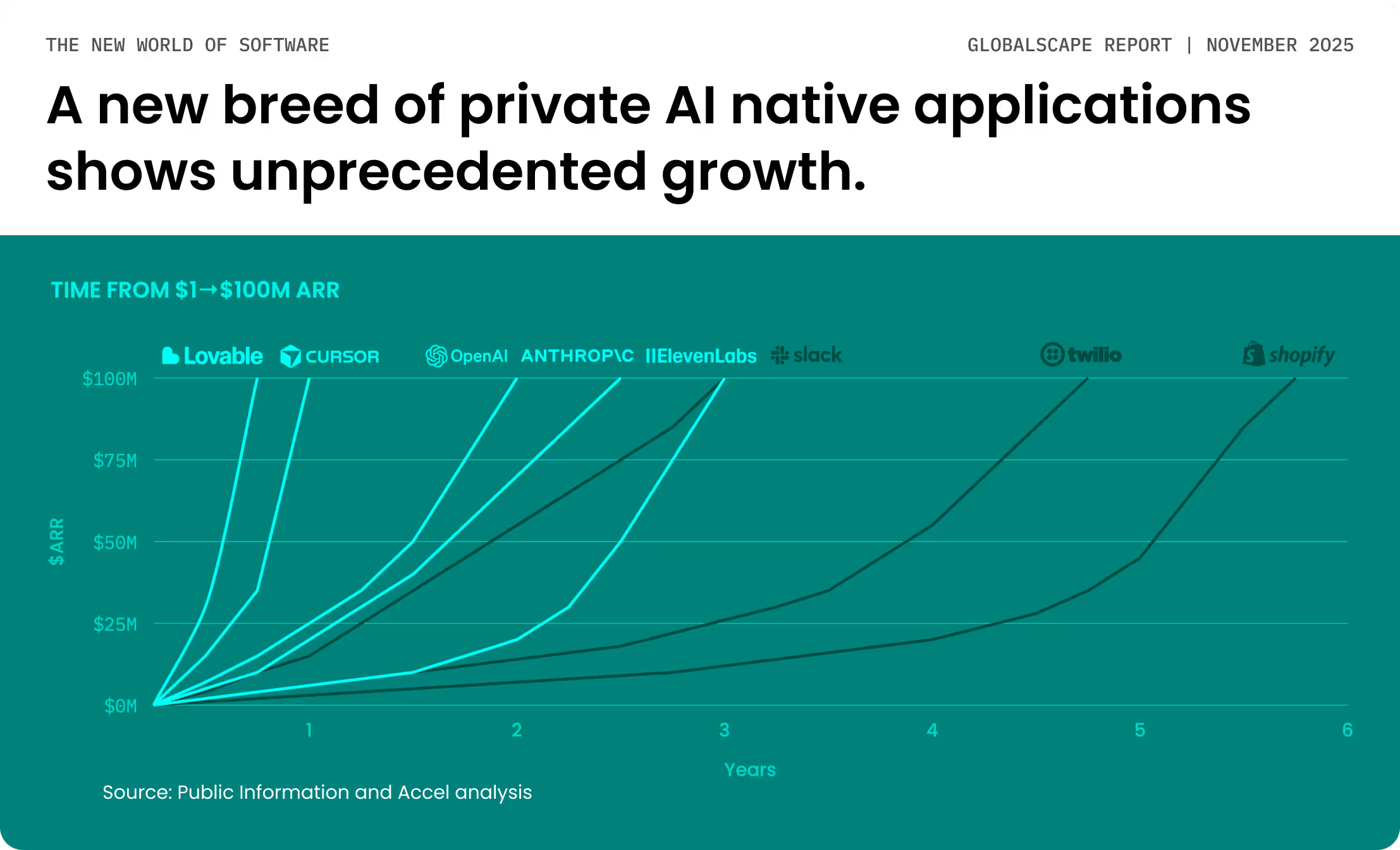
We are witnessing a tectonic shift, with AI accelerating innovation across the globe and unprecedented growth in AI native applications and enterprise agentic workflows. This shift will require an estimated $4 trillion investment in computing data centers over the next five years.

Report
Report
Report
Report
Report
Report
Report
Report