|
|
The Last Warrior Kurdish 【ESSENTIAL】Why, then, do we still speak of the "Last" Kurdish Warrior? Because he stands at a precipice. In the cities of Erbil and Sulaymaniyah, a new generation is emerging—Kurds with university degrees, iPhones, and a desire for economic stability, not mountain warfare. The older Peshmerga , many now in their fifties and sixties with aching knees and the thousand-yard stare of a hundred firefights, find themselves obsolete. The "Last Warrior" is the bridge generation: those who remember the chemical attack on Halabja (1988) and the decades of Saddam’s Anfal genocide, but who cannot teach their children to live the same life of stateless violence. Yet, to declare him extinct would be a fatal misreading of the Middle East. As long as the Kurdish nation remains the largest stateless ethnic group in the world, divided by the iron borders of four hostile powers, the warrior will not vanish. He is simply evolving. The modern "Last Warrior" is the female sniper of the YPJ (Women's Protection Units), who shattered every patriarchal norm of the region; she is the software engineer in Qamishli who hacks regime communications; he is the diplomat in Washington D.C. pleading for a weapons deal. The spirit of Peshmerga —the willingness to face death for a language, a culture, and a patch of land—has not died; it has merely changed its uniform. The Last Warrior Kurdish In conclusion, "The Last Kurdish Warrior" is a tragic, beautiful, and necessary myth. He is the last of a breed of classical guerrilla fighters in a world of remote warfare. But he is also the first of a new kind of national defender. As long as the Kurdish dawn has not yet arrived, the warrior cannot be the last. For in the mountains of Kurdistan, the echo of a gunshot fades, but the memory of resistance is passed from mother to child, from fighter to refugee. The title "Last" belongs not to a specific man, but to a fleeting moment in history—the moment just before the next generation picks up the rifle to finish what the ancestors started. The warrior is only "last" until the mountains call again. Why, then, do we still speak of the "Last" Kurdish Warrior The genesis of the Kurdish warrior lies in the geography of Kurdistan itself. The land is a natural fortress of impenetrable gorges and high passes, which for millennia shielded the Kurds from the centralizing armies of the Ottomans, Persians, and Arabs. Here, the warrior was not a professional soldier but a peasant, a herdsman, or a tribal chief who traded his keffiyeh for a rifle at the first sign of invasion. His weapon was the Khanjar (dagger) or the antiquated Mauser rifle, passed down through generations. He fought not for a flag that existed, but for a flag that existed only in the collective dream: the golden sun of the Kurdish flag. This warrior was defined by a code of honor— Jiyan azadi ye ("Life is freedom")—where death in battle was not a tragedy but a testament to the refusal to submit to assimilation. The older Peshmerga , many now in their However, the last decade has witnessed the twilight of this figure. The war against the Islamic State (ISIS) between 2014 and 2019 was the Peshmerga’s finest hour, but also the moment that broke the mold. In Kobani and Sinjar, the Kurdish warrior was no longer a lone horseman but a cog in a mechanized, urban guerrilla force. The enemy was not a neighboring army with a front line, but a digital-era death cult using social media and suicide drones. The response required the YPG (People's Protection Units) and Peshmerga to adopt NATO-style tactics, night-vision goggles, and coalition airstrikes. The romantic individual was replaced by the disciplined unit. After the territorial defeat of ISIS, the warrior faced his most formidable enemy yet: not a foreign army, but the internal politics of Iraq, the shelling by Turkey, and the economic blockade by Baghdad. The rifle is useless against a pipeline blockade. In the rugged, snow-capped mountains where the borders of Turkey, Iran, Iraq, and Syria violently intersect, a specific archetype of human resilience was forged: the Kurdish warrior. Known historically as the Peshmerga —a term meaning "one who faces death"—this figure is not merely a soldier but a living repository of a nation’s memory. To speak of "The Last Kurdish Warrior" is to engage with a profound paradox. In an era of drones, precision missiles, and shifting geopolitical alliances, the classical warrior of the Zagros Mountains is becoming an anachronism. Yet, his existence—real or symbolic—remains the most potent argument for a people who have been denied the oxygen of a sovereign state for over a century. The Last Warrior is a ghost of the past, a reluctant hero of the present, and the only guardian of a future that seems perpetually deferred. |
The Last Warrior Kurdish 【ESSENTIAL】Since different computers have different configurations, some old model computer may install the games slowly. Here is a tip which make your computer speed up in installing the PS2 games:
*NOTE* USB Extreme Win32 utility (Windows GUI) - Allows easy installation from your CD/DVD drive to your USB HDD USBInsane (Windows GUI) - Allows you to install an ISO stored on the PC HDD as well as the CD/DVD drive. USBeXtreme (DOS) - The setup program containing the format and install software The DOS version is more stable and has a higher success rate for proper installations, but is not as simple as the GUI version. So we will guide you thru the DOS version. USBeXtreme User Manual(MS-DOS mode) Before Starting: To use the USBeXtreme on your PS2, you will need a USB Hard drive Enclosure with Hard drive installed (both devices are sold separately), either 3.5' or 2.5' USB Hard drive Enclosure with Hard drive can be use. *For the installation of a Hard Drive into your USB enclosure, please refer to the user manual of the USB Enclosure if its the removable type. Hard Drive preparation If you are using a new
hard drive, you will need to initialize the hard drive with Windows
2000/XP.(For Windows 98/ME
user, you will need other Disk Management software, like, Partition
Magic to initialize and format the harddisk) To initialize the
hard drive, connect the hard drive enclosure to your PC's USB port and install the
driver if its
required, then go to Start
and right
click My Computer >
Manage
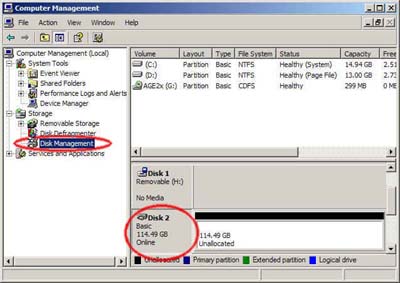
> Disk Management. * For the driver installation, please refer to the user manual of the hard drive enclosure* After that you will able to view all drives installed in your PC, select the newly installed hard drive, right click and choose "initialize", follow the on screen instruction and the hard drive will be initialized by your PC and assign a driver letter to it. You can format the drive by using NTFS format in order to use up the maximum space of the hard drive. Create a Primary Partition of the max space available.
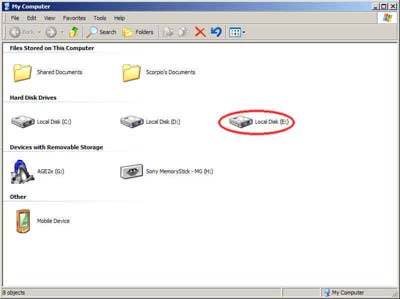
If the hard drive has formatted and assigned a drive letter successfully, you will see a new drive in "My Computer"
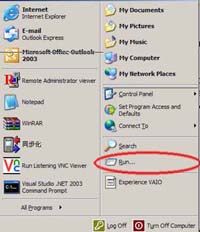
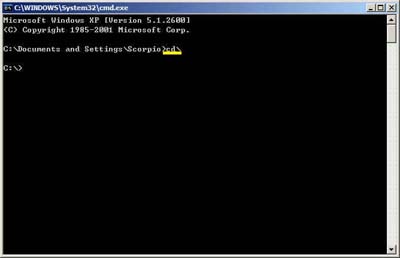
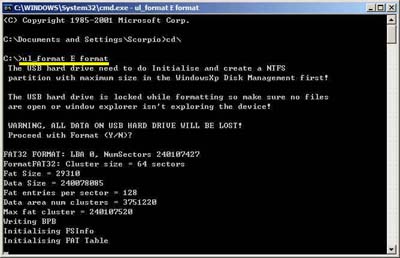
Formatting for USBeXtreme Download the DOS software of USBeXtreme from the link above, unzip the file and run the USBeXtreme_setup.exe file, then the tools will be extracted into the drive C. Please DO NOT change the default installation path except you are familiar with MS-DOS command. After extracted the USBeXtreme Client software, go to "Start" then "Run", Enter "Command" or "CMD" to open a command prompt. Change the directory to the root directory C drive by entering command cd\ and press enter, you will see C:\> appear on the command line. You can refer to the following picture.
Then you can enter the following command. ul_format X format "X" is the drive letter of your USB hard drive.
The format action will take a
few minutes, it is depends on the capacity of the partition you
created, please DO NOT remove the hard drive or power off the USB
harddisk enclosure during this period.
Game Converting To convert games from CD/DVD drive to the USB hard drive, please connect the USB drive to your PC, then go to command prompt "Start" > "Run" > enter Command or CMD, change the directory to the root directory C drive by entering command cd\ and press enter, you will see C:\> appear on the command line. You can refer to the following picture.
This is the DOS command required to install. [color coded for easy understanding] ul_install SourceDrive TargetDrive GameName Disc e.g. if your DVD/CD-Rom drive is drive D, and the USB harddisk is E, and you are converting a PS2 DVD game "Metal Gear Solid", the command will be the following ul_install D E MetalGearSolid DVD you can refer to the following picture 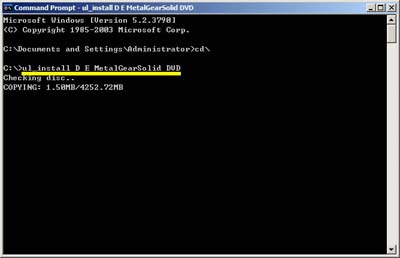
Game converting will take a
few minutes depending on the game disc size.
Game Playing Connect and power on the USB
harddisk to your PS2 and boot your PS2 with USBeXtreme, when you see
the game selection menu, select the game and press X on the joypad, the
game will then run immediately.
|
  
|