Welcome back!
Ready to check out?
You're just one click away from fantastic style and even better savings!
Life in India is punctuated by rituals. A day often begins with a bath, the lighting of a lamp in the household shrine, and the drawing of a rangoli (colored powder design) at the doorstep to welcome prosperity. There are rituals for waking up, eating, festivals, and every major life milestone. This isn't just superstition; for many, it is a mindful anchor in a chaotic world.
To understand Indian culture is to step into a living, breathing kaleidoscope. It is not a single story, but a million of them—running on parallel tracks of ancient tradition and 21st-century ambition. India is a land where a cutting-edge IT professional might start their day with a yoga asana codified 5,000 years ago, then end it by checking the stock market on a smartphone before a family puja (prayer). The Pillars of Daily Life 1. The Joint Family System At the heart of Indian lifestyle is the concept of the family. While nuclear families are rising in cities, the ideal of the "joint family" (parents, children, grandparents, uncles, and cousins living together) remains powerful. Decisions—from career moves to marriage—are often discussed collectively. Respect for elders is non-negotiable, visible in the simple act of touching feet ( pranam ) as a greeting.
Life in India is punctuated by rituals. A day often begins with a bath, the lighting of a lamp in the household shrine, and the drawing of a rangoli (colored powder design) at the doorstep to welcome prosperity. There are rituals for waking up, eating, festivals, and every major life milestone. This isn't just superstition; for many, it is a mindful anchor in a chaotic world.
To understand Indian culture is to step into a living, breathing kaleidoscope. It is not a single story, but a million of them—running on parallel tracks of ancient tradition and 21st-century ambition. India is a land where a cutting-edge IT professional might start their day with a yoga asana codified 5,000 years ago, then end it by checking the stock market on a smartphone before a family puja (prayer). The Pillars of Daily Life 1. The Joint Family System At the heart of Indian lifestyle is the concept of the family. While nuclear families are rising in cities, the ideal of the "joint family" (parents, children, grandparents, uncles, and cousins living together) remains powerful. Decisions—from career moves to marriage—are often discussed collectively. Respect for elders is non-negotiable, visible in the simple act of touching feet ( pranam ) as a greeting.
*Discount applied on the current website price at the time of order. Offer only valid for new customer first contacts order over $10. Maximum discount of $100. Cannot be combined with any other offers. Promotions are subject to change without notice. We reserve the right to cancel orders that are in breach of the terms and conditions of this offer.




| Lens Width | Bridge Width | Temple Length | |
|---|---|---|---|
| XS | < 42 mm | < 16 mm | <=128 mm |
| S | 42 mm - 48 mm | 16 mm - 17 mm | 128 mm - 134 mm |
| M | 49 mm - 52 mm | 18 mm - 19 mm | 135 mm - 141 mm |
| L | >52 mm | >19 mm | >= 141 mm |
Buying eyewear should leave you happy and good-looking. Use our sizing tool to find frames that best fit your unique facial measurements.
Grab a regular card with a magnetic stripe on the back. Student IDs, credit cards and gift cards work well to start our online PD tool.
You may have received our paper PD measurement tool in your recent online order. In order to use this tool, place the ruler on your eyes so that the "0" lines up at the centre in between your eyes. Add up the two numbers, to get your PD. See example below:
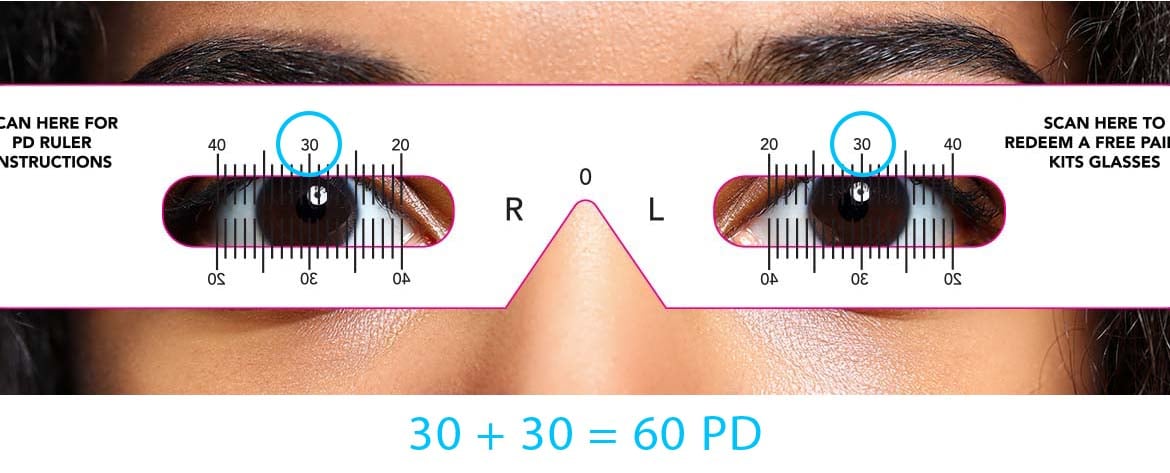
Click on this link to download and print your own PD measurement tool.
DOWNLOAD



 Check order status
 Place reorder
 Chat with us





 Use your insurance
 Help
Help